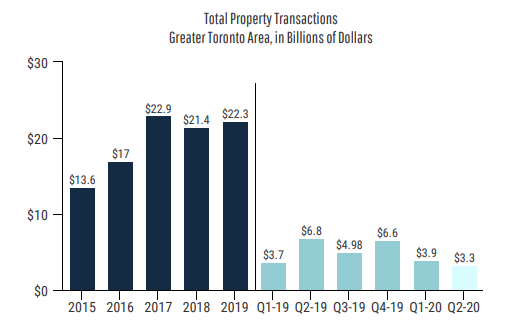
The impact of the pandemic on the Greater Toronto Area commercial real estate market began to surface during Q2-2020. The number of sales decreased by 27% quarter-over-quarter and by 38% year-over-year to 229 transactions. The total value of sales recorded in the second quarter fell to $3.3 billion across the GTA, representing a decrease in value of 16% quarter-over-quarter and 52% year-over-year. The last time total sales volume was this low was in Q1-2016 ($3.1 billion). It’s important to note that most of the sales that closed during Q2-2020 were based on sale agreements made during the pre-pandemic period, meaning the full initial impact on the data from COVID-19 will continue in the coming quarters.
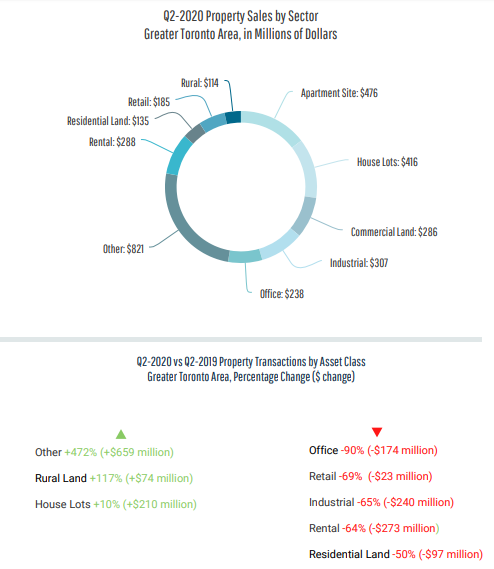
Annual declines in the total value of sales were experienced by the majority of asset classes, falling the most for office buildings at 90% (-$174 million), followed by retail buildings (-69%; -$23 million), industrial (-65%; -$240 million), rental buildings (-64%; -$273 million), low-density residential land (-50%; -$97 million), apartment sites (-48%; -$719 million), and commercial land (-29%; -$18 million).
The average sale value across all asset categories was $14 million, representing a 23% decrease year-over-year. Despite a slowdown in sales, the average price per square foot for retail buildings continued to rise, reaching a record $653 psf due to several high-valued sales in the downtown core. As well, the average price per square foot for industrial buildings remained 6% higher than a year ago at $177 psf, while the average price per square foot for office buildings rose quarter-over-quarter for the first time in five quarters to $375 psf, which was 11% lower than in Q2-2019. For residential land, the average price per acre reached its highest level in two years at $703,000.
House lots experienced an annual gain of 10% (+$210 million), with the largest subdivision sales located in the New Seaton Community in Pickering, Glen Abbey Encore in Oakville, Reesor Ridge at Wismer in Markam and Pathways in Caledon. Also, rural land sales increased in total value by 117% (+$74 million).
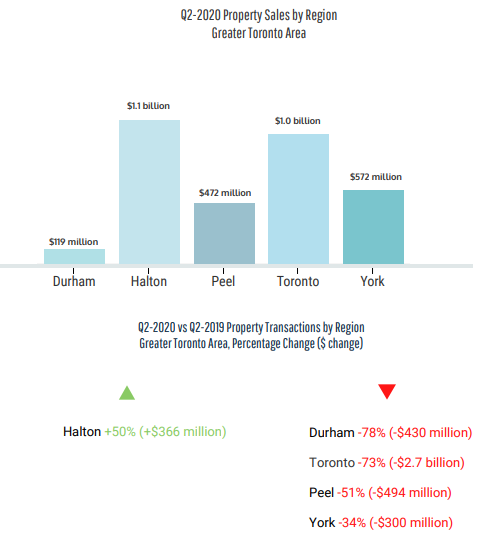
The sale of the Halton Hills Generating Station ($750 million) contributed to an annual gain of 472% (+$659 million) for the "other" category. The sale of this generation station also contributed to an annual gain of 50% (+$366 million) for Halton Region.
Annual declines were experienced by all other Regions, with the largest decreases experienced by Durham Region at 78% (-$430 million), followed by Toronto (-73%; -$2.7 billion), Peel (-51%; -$494 million), and York (-34%; -$300 million).
Latest Research
August 25, 2026
ONTARIO STILL FACING 121,000-UNIT RENTAL SHORTAGE DESPITE RECORD CONSTRUCTIONJuly 27, 2026
GTHA RENTAL MARKET SHOWS IMPROVEMENT IN Q2July 20, 2026
GTHA NEW CONDO SALES INCREASE OVER 50% IN Q2June 23, 2026
Ontario Student Housing Deliveries Set to Reach Record in 2026May 4, 2026
Over Half of Ottawa Rental Buildings Offering IncentivesApril 26, 2026
GTHA Rental Vacancy Rises to 5.4% in Q1
In The News
August 25, 2026
Report finds Ontario’s rental housing gap persistsJuly 28, 2026
GTHA rental market shows improvement in Q2July 21, 2026
Bulk investor buying helps resuscitate condo purchases in the Toronto regionJuly 21, 2026
New condo sales in the GTHA were up for the first time in 3 years, but report says supply now ‘thinning quickly’April 30, 2026
Incentive offers rise as apartment operators compete with condos for tenantsApril 28, 2026
The vacancy rate is up for new Toronto area rental buildings, so why is it still so expensive to rent?