BULK PURCHASES & HST RELIEF DRIVE A SECOND CONSECUTIVE QUARTERLY GAIN
TORONTO – October 19, 2026: Urbanation Inc., the leading source of information and analysis on the condominium market since 1981, released its Q3-2026 Condominium Market Survey results today.
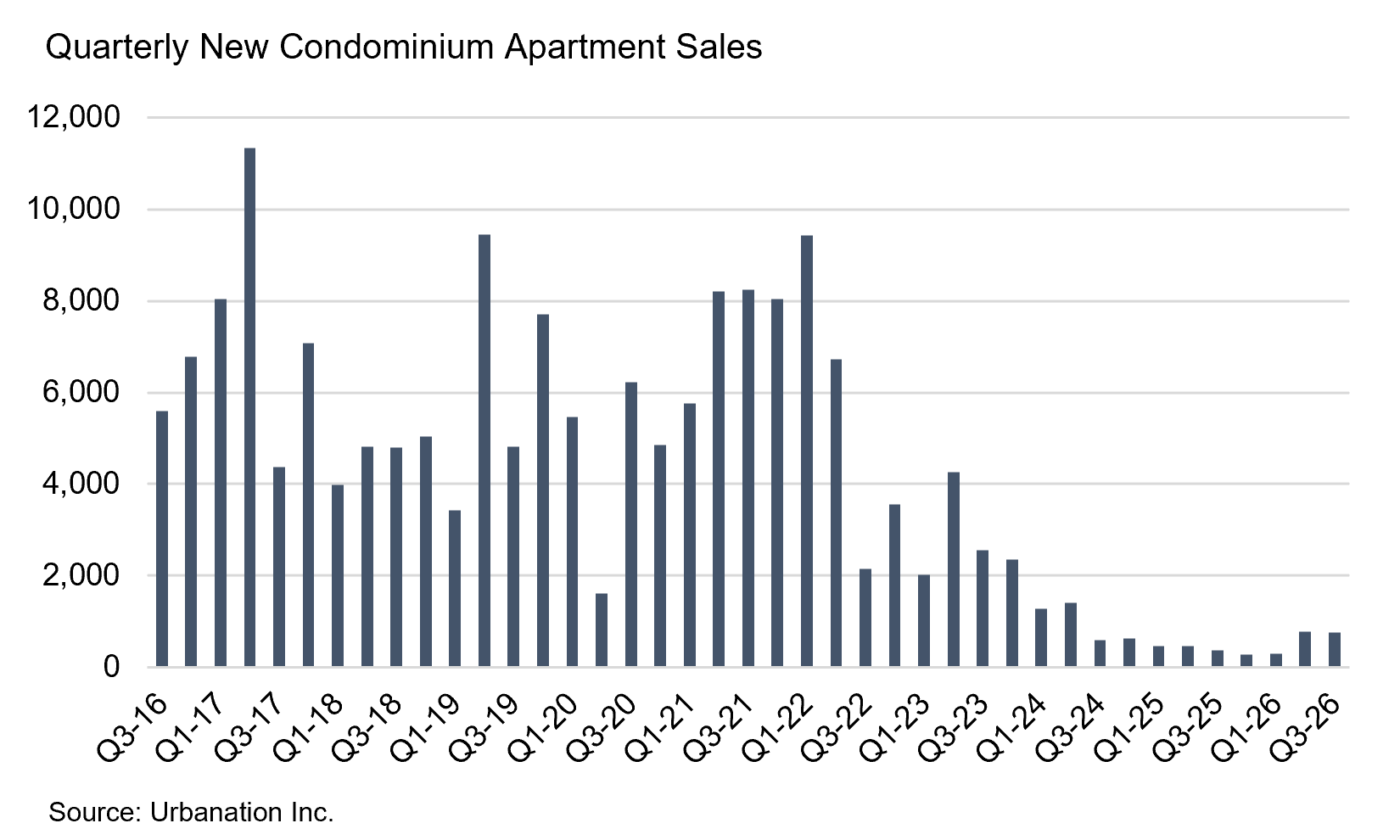
New condominium apartment sales in the Greater Toronto Hamilton Area (GTHA) doubled from a year ago to 760 units in Q3-2026, the second consecutive quarter of growth, as HST relief and bulk purchases by investment groups continued to lift activity off the 35-year lows recorded at the start of the year. Sales over the past two quarters totalled 1,531 units, roughly equal to the 1,578 units sold in all of 2025. Still, Q3 sales remained 78% below the latest 10-year average for third quarter periods.
Bulk sales continued to play a major role in the recovery. Investment groups acquired 339 units in bulk transactions in Q3, accounting for 45% of total new condo sales. As a result, sales at completed buildings reached a record high of 648 units in Q3, representing a record 85% share of total new condo sales. Pre-construction sales moved in the opposite direction, falling 61% annually to just 60 units, the 12th consecutive quarter of annual declines. Ontario's enhanced HST rebate requires units purchased as rentals to be substantially completed by December 31, 2029, two years earlier than units bought by owner occupiers, a deadline that most new high-rise projects cannot meet given construction timelines of four to five years. This effectively excludes pre-construction investors from the enhanced HST rebate.
Higher absorption has started to reduce standing inventory. Completed and unsold inventory edged down 7% from a record 5,485 units in Q2 to 5,127 units in Q3, the first quarterly decline in four years. However, completed and unsold inventory remained 40% higher than a year ago and four times higher than two years ago, when it totalled 1,279 units.
Average asking prices for completed and unsold new condos were $1,157 psf in Q3, down 4% from a year ago and 20% below the market peak of $1,446 psf in Q2-2023. For the new condo units that sold in Q3, prices averaged $1,045 psf excluding bulk and luxury transactions. Bulk sales transacted at an average of $763 psf, an average discount of 40% to the original selling prices in the same buildings.
In the resale market, condo sales declined 6% annually to 3,843 units in Q3, active listings fell 11% to 7,020 units, and average prices decreased 5.7% to $724 psf, the smallest annual decline in six quarters. Prices held up much better in the core, where average resale prices in the former City of Toronto fell only 2.8% annually to $905 psf, compared with declines of 7.9% in the outer 416 and 9.3% in the 905. The former City of Toronto also recorded the fewest new condo completions of any region over the past 12 months at 6,884 units, down 30% from a year earlier.
On the supply side, construction starts totalled just 381 units in a single project in Q3, bringing starts for the first three quarters of 2026 to 2,696 units, 82% below the 10-year average for the same period. Completions slowed to 2,578 units in Q3, the lowest quarterly total since Q4-2019. Year-to-date completions of 17,051 units were down 17% from the record 20,506 units completed over the first three quarters of 2025.
Units under construction fell 38% annually to 35,920 units in Q3, the lowest level since early 2012 and 66% below the 2023 peak of 104,796 units. Of the units under construction, 7,685 remain unsold. Scheduled completions total 3,817 units in Q4-2026, bringing completions for the full year to 20,868 units, down from 29,077 units in 2025. Completions are then scheduled to fall to 15,825 units in 2027, 12,065 units in 2028 and 4,213 units in 2029.
“Two straight quarters of higher sales show that buyers will step in at the right price. Bulk investors are acquiring completed units at heavily discounted prices, which is helping to manage standing inventory. But with the pre-construction market remaining dormant and construction starts at historic lows, the supply pipeline is drying up, setting the market up for a significant shortage by the end of the decade.”
—Shaun Hildebrand, President of Urbanation
Latest Research
October 19, 2026
GTHA New Condo Sales Double from a Year Ago in Q3August 25, 2026
ONTARIO STILL FACING 121,000-UNIT RENTAL SHORTAGE DESPITE RECORD CONSTRUCTIONJuly 27, 2026
GTHA RENTAL MARKET SHOWS IMPROVEMENT IN Q2July 20, 2026
GTHA NEW CONDO SALES INCREASE OVER 50% IN Q2June 23, 2026
Ontario Student Housing Deliveries Set to Reach Record in 2026May 4, 2026
Over Half of Ottawa Rental Buildings Offering Incentives
In The News
September 24, 2026
High Art Capital pays $22.3 million to bulk buy 43 unsold condos along Eglinton LRT routeSeptember 23, 2026
Rents in tariff-exposed cities fall faster than those least affected by trade warAugust 25, 2026
Report finds Ontario’s rental housing gap persistsJuly 28, 2026
GTHA rental market shows improvement in Q2July 21, 2026
Bulk investor buying helps resuscitate condo purchases in the Toronto regionJuly 21, 2026
New condo sales in the GTHA were up for the first time in 3 years, but report says supply now ‘thinning quickly’