DEVELOPERS FACING BUYER DEFAULTS & RECORD HIGH PROJECT CANCELLATIONS
TORONTO – January 21, 2026: Urbanation Inc., the leading source of information and analysis on the condominium market since 1981, released its year-end 2025 Condominium Market Survey results today.
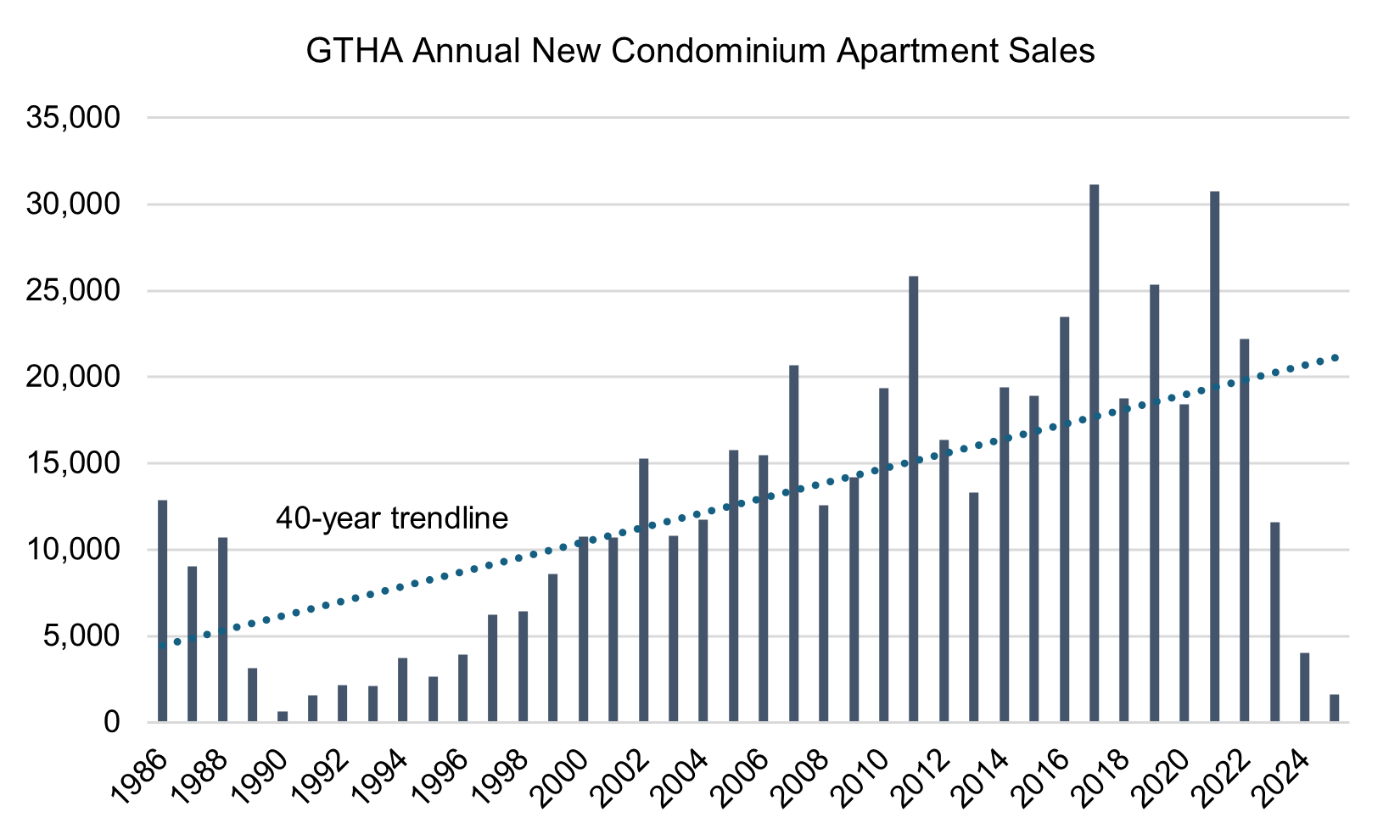
New condominium apartment sales in the Greater Toronto Hamilton Area (GTHA) declined for the fourth consecutive year in 2025, decreasing 60% from 2024 to a total of 1,599 units — the lowest annual result since 1991. New condo sales in 2025 fell 91% below the 10-year average and have dropped 95% since 2021. Activity showed no signs of improvement in Q4-2025 as the 262 units sold represented the lowest quarterly total since Q3-1990.
In 2025, a record-high 28 active new condominium projects totaling 7,243 units were cancelled, more than doubling the units cancelled in 2024 (3,469) and the previous high in 2018 (3,598). Eight cancelled condo projects totaling 2,189 units switched to purpose-built rental in 2025, adding to the 1,434 cancelled condo units that converted to rental in 2024.
The conversion of some cancelled condo projects to purpose-rental was not enough to help offset a steep decline in condominium starts. While purpose-built rental starts grew 24% from 6,908 units in 2024 to 8,545 units in 2025 (a multi-decade high), condo construction starts fell 63% from 8,854 units in 2024 to 3,272 units in 2025 (a multi-decade low). In the last three years, condo starts have plunged 88%, bringing the total inventory under construction down to a 10-year low of 50,479 units.
Developers launched only 10 new condo projects in 2025, including one project brought to market in Q4-2025. The 1,425 units launched last year were 22% sold, down from a 24% sales rate for new launches in 2024 and a high of 81% for new launches in 2021. Sales continued to fall in 2025 despite average selling prices within new launches declining to a five-year low of $1,123 psf — down 8% from 2024 and an 18% drop from 2022. New condominium prices remained at a significant premium over comparable resale units, which averaged selling prices of $856 psf in Q4 for condos completed in the past three years.
As investors moved to the sidelines, new condo sales have pivoted away from pre-construction projects towards newly completed projects. In 2025, a record high 33% share of new condo sales were in projects in the occupancy and registration stages, surging from a 9% share in 2024 and a 2% share in 2023. Meanwhile, pre-construction projects, which have typically comprised more than 70% of new condo sales, represented less than half of sales last year for the first time. This illustrates the shift in the market towards more end-user purchasers, who have benefited from an increased supply of completed and unsold units.
As of year-end 2025, completed and unsold inventory reached a record high of 3,897 units, a 131% increase from a year earlier (1,690 units) and five times higher than the level from two years ago (755 units). In addition, developers are dealing with completed units that were pre-sold, but the purchaser failed to close. Urbanation’s research into land registry records indicates that approximately 10% of pre-sold new condos that were registered in 2025 were taken back by developers, equivalent to roughly 3,000 units.
Unsold inventory has been pushed higher as sales have decreased and completions have hit record highs during the past two years. A total of 29,291 condo units were completed in 2025, nearly matching the record high of 29,924 units completed in 2024 and 50% higher than the 10-year average. Completions are expected to decrease by 25% in 2026 to 22,066 units before dropping to 14,366 units in 2027 — less than half the level in 2025. By 2029, virtually no new condos are expected to be delivered.
“As the condo market enters the fifth year of its largest ever correction, the duration of this downturn should be a significant cause for concern as it relates to future supply. By the end of the decade, we know with certainty that there won’t be any new condo completions. What we don’t know is how far into the 2030s the supply crunch will last. If rental construction can’t fill the void, this raises serious questions around the impact on affordability.”
—Shaun Hildebrand, President of Urbanation
Latest Research
October 19, 2026
GTHA New Condo Sales Double from a Year Ago in Q3August 25, 2026
ONTARIO STILL FACING 121,000-UNIT RENTAL SHORTAGE DESPITE RECORD CONSTRUCTIONJuly 27, 2026
GTHA RENTAL MARKET SHOWS IMPROVEMENT IN Q2July 20, 2026
GTHA NEW CONDO SALES INCREASE OVER 50% IN Q2June 23, 2026
Ontario Student Housing Deliveries Set to Reach Record in 2026May 4, 2026
Over Half of Ottawa Rental Buildings Offering Incentives
In The News
October 20, 2026
Investors buying unsold Toronto condos at 40% discount to original selling price, report findsOctober 20, 2026
Almost half of Toronto area new condo sales are now bulk sales at a huge discountSeptember 24, 2026
High Art Capital pays $22.3 million to bulk buy 43 unsold condos along Eglinton LRT routeSeptember 23, 2026
Rents in tariff-exposed cities fall faster than those least affected by trade warAugust 25, 2026
Report finds Ontario’s rental housing gap persistsJuly 28, 2026
GTHA rental market shows improvement in Q2